Papers
1914
The Montaukett and the court record
A New York appeals court denied the Montaukett's continued tribal existence. Its opinion shows the racial reasoning behind that decision.
Pharaoh v. Benson, 164 A.D. 51 (1914) • Source status checked October 24, 2026
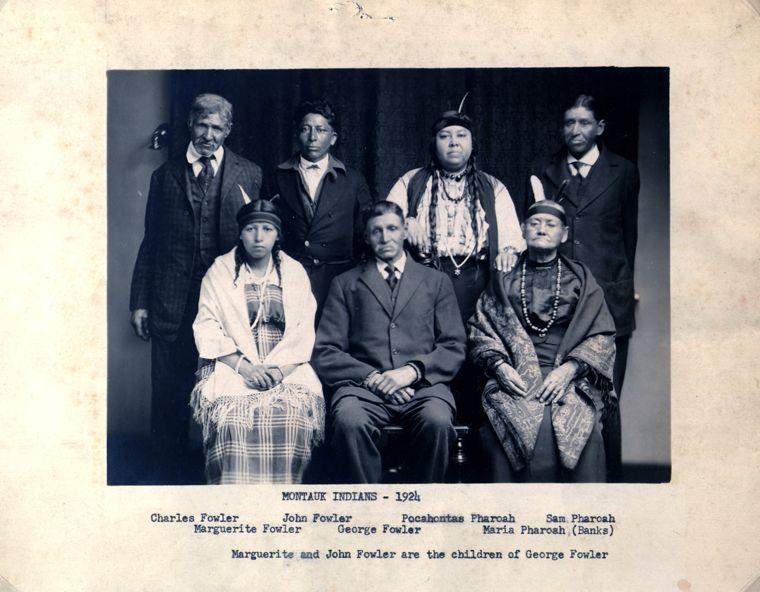
Credit: The East Hampton Library, Long Island Collection. Educational use.
View the library catalog and usage statement
The government action
In 1910, a New York court declared the Montaukett extinct. In 1914, the Appellate Division upheld the judgment in Pharaoh v. Benson. The case concerned the Montaukett's rights in about 4,200 acres at Montauk Point, Long Island, known as Indian Field.
The appellate opinion treated tribal existence as a legal question and said the Montaukett no longer existed as a tribe. Its reasons included racial mixture and assimilation. This was a court's classification of a living community, not proof that its people had disappeared.
The 1910 description is corroborated by the 2026 recognition bill's sponsor memo. The 1914 opinion is the primary source for the reasoning below.
The court's words
How the opinion denied tribal existence
The following are faithful excerpts from the published 1914 opinion, not photographs of an original court file. The racial terminology is the court's language.
"at the time of the commencement of this action there was no tribe of Montauk Indians"Pharaoh v. Benson, 164 A.D. 51, 53 (1914), quoting the lower court's finding
"the purity of blood was greatly impaired by miscegenation, particularly with the negro race"Same opinion, page 53
"they have adopted the habits and customs of civilized life and become members of a civilized community"Same opinion, page 53
What the record shows
The court used intermarriage, work, customs and the absence of a separate tribal government as reasons to reject continued tribal existence. It treated racial mixture and assimilation as evidence against the Montaukett.
The opinion also discussed separate property and procedural grounds, including the validity of releases and alleged abandonment of occupancy rights. It does not support reducing every land transaction to one racial finding.
Read the full opinion: Pharaoh v. Benson, 164 A.D. 51 (1914). Justia reproduces the published judicial text; this is not an original-file scan.
The continuing fight
Recognition is still unresolved
The Montaukett are seeking recognition by New York State. Recognition bills passed the Legislature and were vetoed under governors Andrew Cuomo and Kathy Hochul. The dated records below document those actions.
| 2017 | Cuomo veto: A2325, veto message 174. New York State Archives |
| 2018 | Cuomo veto: S7770, veto message 360. New York State Archives |
| 2023 | Hochul veto: S6721 / A6919, veto 61. New York State Senate record |
| 2024 | Hochul veto: S8550 / A9124. New York State Senate record |
| 2026 | A10129 / S9092 passed both chambers. As checked October 24, the bill record showed no delivery to the governor or enactment. Current bill and action history |
Read the reporting
Jason Motlagh's October 22, 2026 Rolling Stone report describes the Montaukett's recognition fight and reports that Montaukett members were sitting in the courtroom when the tribe was declared extinct. That attendance detail is attributed to the reporting; we have not recovered a separate attendance record.
Read the full Rolling Stone report. Its photographs are not reproduced here.
The court's declaration did not erase the Montaukett people. This page documents what the government wrote and distinguishes that record from the community's continued existence. State recognition and a land-rights judgment are different questions.
← All papers