1898
The Dawes rolls
From 1898 to 1914, a federal commission decided who counted as a citizen of the Five Tribes — and sorted families into categories.
Two lists
The rolls for the Cherokees . . . resulted in two lists: a “Blood Roll” for native Cherokees, and a “Freedmen Roll” for former slaves and their descendants.U.S. Court of Appeals for the D.C. Circuit, Vann v. Kempthorne (2008), quoted in Cherokee Nation v. Nash (2017)
The National Archives’ own guide lists the enrollment categories side by side: “Citizens by blood (BB),” “Freedmen (F),” “Minor Freedmen (FM),” “Newborn Freedmen (FNB).” And the two kinds of cards did not ask the same questions:
Cards for Freedmen applicants include fields for “slave of,” “father’s owner,” and “mother’s owner” as well.National Archives, “Dawes Records”
A Freedmen card
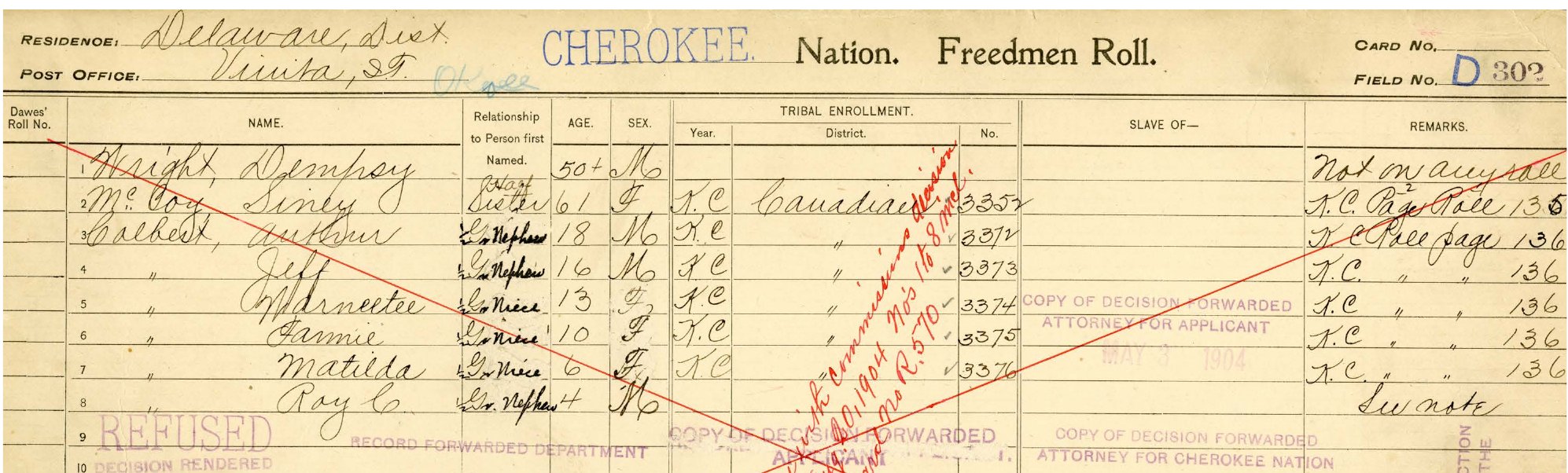
A Cherokee Nation Freedmen Roll census card, from the National Archives’ published sample. The commission recorded who had enslaved the applicant’s family. This family’s application was refused.
What it means
Same families, two lists. The list a family landed on more than a century ago still decides citizenship claims today.
Sources
National Archives, Dawes Records
National Archives Catalog, Enrollment Cards, 1898–1914 (Identifier 251747)
Cherokee Nation v. Nash, memorandum opinion (2017), via GovInfo
← All papers